
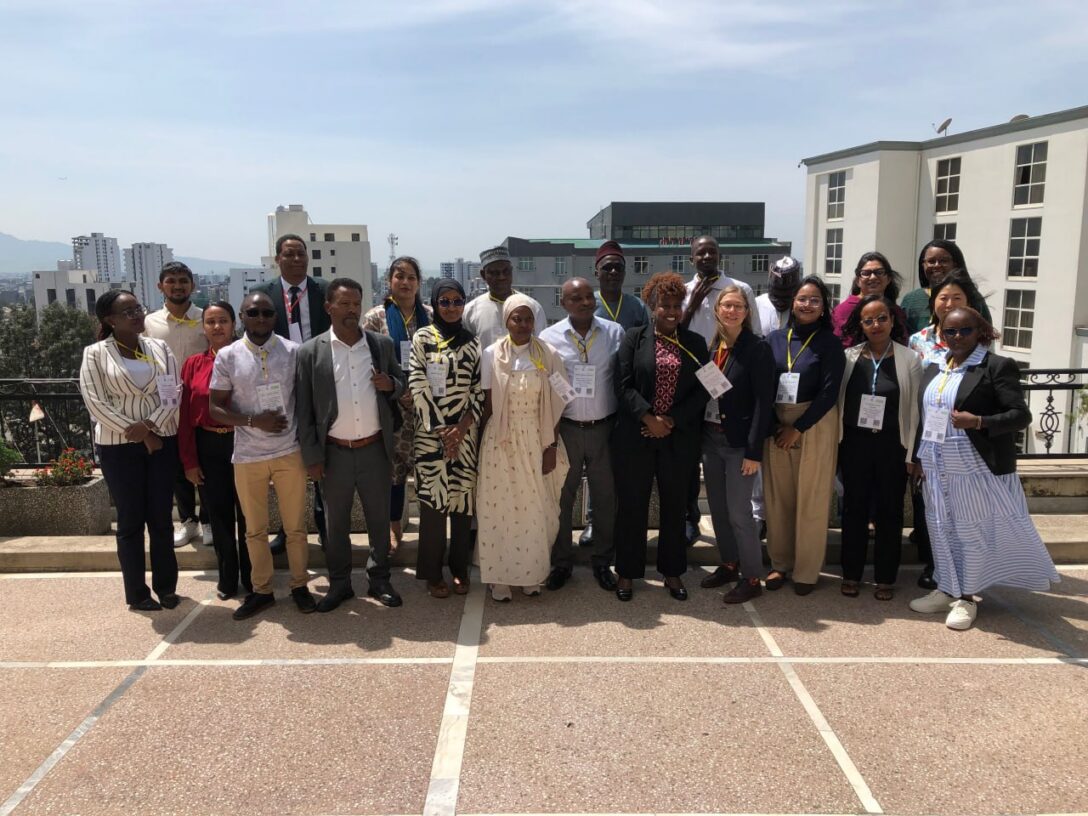
Held from September 22–24 at Haile Grand Addis Ababa, the workshop brings together partners and stakeholders from GCAN’s five focal countries—Ethiopia, India, Kenya, Nigeria, and Senegal. Led by the International Food Policy Research Institute (IFPRI), GCAN supports the integration of gender equality, climate resilience, and nutrition into policies, programmes, and research.
The Addis Ababa workshop builds on discussions from the previous GCAN partner workshop held in Nairobi in June 2025. That meeting highlighted the need to strengthen technical and institutional capacity, improve cross-sectoral coordination, generate and communicate actionable evidence, strengthen monitoring and evaluation, and expand opportunities for cross-country learning.
Opening the workshop, Professor Tegegne Gebre-Egziabher, Executive Director of the Forum for Social Studies (FSS), emphasized the broader significance of GCAN for partner countries beyond evidence generation. He emphasized, GCAN
“is about institutional strengthening as it strengthens the capacity of institutions and fosters cross-sector collaboration. It is about policy integration as it supports the integration of gender, climate adaptation and nutrition into policies, programs, and development practices and it is about multi stakeholder collaboration as it brings together academic and research institutions, government agencies, civil society organization and development partners around a common goal.”
The first day of the workshop focusses on GCAN’s progress to date and partners’ aspirations for the initiative through 2028. Elizabeth Bryan, Research Fellow at IFPRI, presented an overview of progress under the initiative, providing a basis for participants to reflect on GCAN’s journey, achievements, lessons, and priorities for the next phase. An interactive session is further enabling partners to identify common priorities and opportunities for strengthened collaboration.
A key focus of the second day is capacity strengthening. Partners are sharing experiences from their capacity-strengthening roadmaps and exploring how tools, training materials, guidelines, and approaches developed in individual countries can be adapted and shared across the wider GCAN network.
Policy engagement and communications are also central to the discussions. Drawing on experiences from across the five countries, partners are examining approaches such as stakeholder consultations, policy dialogues, technical working groups, multi-stakeholder platforms, advocacy, and research dissemination.
The workshop will also connect research with policy and practice. On the third day, GCAN will host a stakeholder consultation on reducing post-harvest loss of nutrient-dense foods, featuring evidence presented by Catherine Ragasa, Senior Research Fellow at IFPRI.
The workshop is expected to conclude with agreed priorities, next steps, and action points to strengthen GCAN’s collaborative work through 2028, while supporting Ethiopia’s contribution to the wider partnership.